19th-22nd October 2011
As he nears the end of his career, psychiatrist Martin Dysart is suddenly confronted by the fascinating case of Alan Strang.
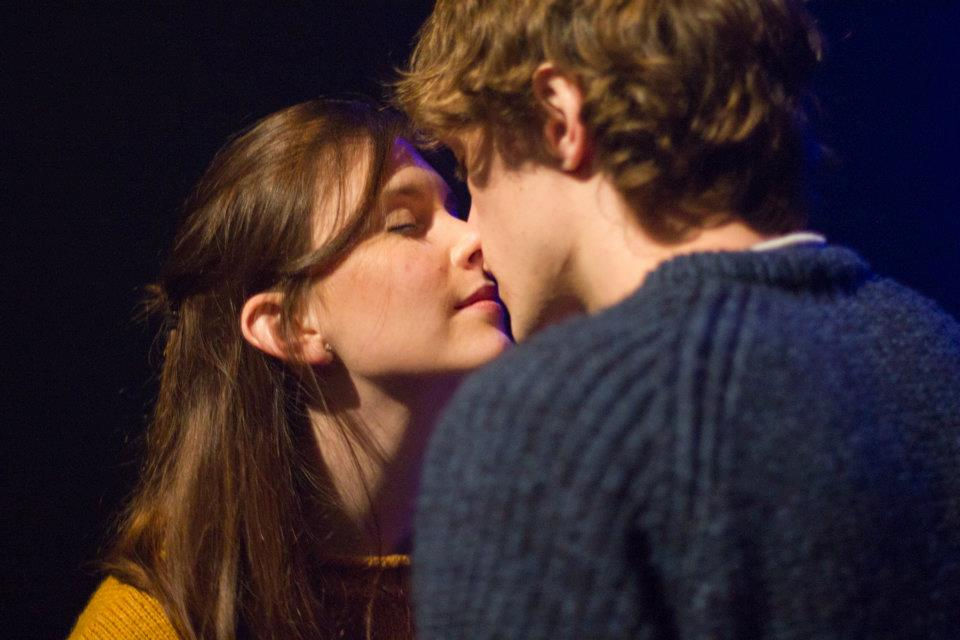
Seventeen-year-old Alan is fought over by his religious mother and atheist father, and something drives him to blind six horses with a metal spike.
To understand Alan’s brutal crime, Dysart must uncover secrets about his parents, his childhood and his relationship with a stable-girl, and the psychiatrist finds himself paradoxically in the witness box.
A savage and passionate play that drives us all to question what it is that makes us human.
Equus
by Peter Shaffer



Director's Note:
Writing this note, during which I should probably try and describe my experience of directing in as few words as possible, is difficult to accomplish with any sense of retrospect or looking back; as I write, there are still ten days to make the seemingly inconceivable leap from rehearsals in the Union to the fully-fledged, lit-up production that is sitting in my head. I hope, for my sake and yours, that, as you read this, the objective has just been or is about to be achieved.
It is safe to say that Equus has been far bigger than I expected, in almost every imaginable way. What I believed to be quite a simple decision to do ‘that play about the horses’ has inexplicably led to a seemingly endless troop of designers, artists and technicians dedicating their time to creating the aesthetics to bring this play to life. To this band of merry men and women, I am eternally grateful.
This play wouldn’t pack half the punch it does if it weren’t for all of you, so thank you.
To the horses – thank you for agreeing to gallop. You do it so magnificently.
To Alison – thank you for Efes. Turkish food is fantastic. And for coffee-related predictive text.
To James – thank you for being on the ball. You are a perfectionist and a grafter, and a haplessly brilliant human being.
To Kat – thank you for doing things that I just can’t. You have assembled and directed your team with such efficiency and flair, and I don’t really understand how.
To Liz – there are no real words. Thank you for letting me use your internet. And thank you for pizza. Here’s to the bucket list at the back of your diary.
To everyone who has taken the time to ask how things are going – it means more than you’d probably think, so thank you.
To the cast – every single one of you is so incredibly talented. You have never failed to astound me with your enthusiasm, support and dedication, and I hope I have held up my end of the bargain. Thank you for working so much harder than most people will ever know, and for becoming such good friends of mine. I’m more than confident that you’ll give the performances you deserve. Enjoy it.
Cast and Crew:
CAST
Dr. Martin Dysart – Arsalan Sattari
Alan Strang – Tom Dixon
Frank Strang – Paul Hilliar
Dora Strang – Charlie Steele
Jill Mason – Bethan Ratcliffe
Hesther Salomon – Lucy Kempster
Nurse – Helena Bradbury
Horseman & Nugget – Andy Beasley
Dalton & Trojan – Nathan Buckley
Horse ensemble – Ed Crowther, Adam Renvoize, Rachel Turner, Lucy Weston
PRODUCTION TEAM
Director – Stuart Gresham
Production Manager – Liz Johnson
Art Director – Kat Chapman
Stage Manager – James Donnelly
Producer – Alison Cryan
CREW
Lighting Designer – Chris Irving
Sound Designer – Katy Robinson
Set Designer – Sarah Balchin
Costume – Sarah Rubini, Rachel Wassell
Art Team – Kat Bradfield, Laura Elliott, Heather Newson, Eleanor Rothwell, Jess Waller, Katarina Warren, Lucy Weston, Catherine Woolley
Horse Eye Technicians – Matthew Robinson, Stephen Fry
Lighting Operator – Hamish Ellis
Sound Operator – Oli Godwin
SuTCo AUTUMN SEASON 2011 AWARDS
Best Show – Equus
Best Tech – Equus
Best Actor – Arsalan Sattari
Best Director – Stuart Gresham
Reviews
A compelling play exploring the inner psyche of both psychiatrist and patient, Equus deals with issues surrounding social conditioning and explores exactly what it is that makes us human. The simple yet effective set designed by Sarah Balchin helped to avoid the many difficulties that come with staging a piece concerning provocative themes set in different locations.
Combined with the lighting (Chris Irving), new spaces and atmospheres were instantly created, enabling a smooth transition from the lighter, comic exchanges between father, girlfriend and son to the darker, quite fearsome instances in which we delve into the patient’s mind.
Few hiccups were evident; the occasional quiet speech or blocking of another actor were minor issues that were soon rectified by the strong ensemble cast. Paul Hilliar and Charlie Steele were excellent in the supporting roles of the protagonist Alan Strang’s parents – although both young themselves, they were believable in portraying the strains of married life alongside the morals and mannerisms of an older generation. Bethan Ratcliffe was also thoroughly enjoyable as love interest Jill Mason; completely at ease in the key role her character plays in exposing Alan’s mental state, her warm persona and infectious, girlish giggle provided an antidote to some of the heavier scenes in the play.
Equus is a play surrounded by controversy, however after experiencing Tom Dixon’s take on the character of Alan it is easy to forget that Harry Potter star Daniel Radcliffe famously played the role before him. Both mature and gripping in performance, Dixon was able to meet the requirements of the demanding part by transforming from a young adult to a child, from someone seemingly content with life to a disturbed psychiatric patient with ease. He managed to not only evoke fear from the audience with his blank stare and contorted form, but also somehow maintain a likeability throughout – a far from easy task when playing a boy convicted of blinding six horses.
A play with so many plot twists needs a central character to bind it all together; this can be found with Arsalan Sattari as the psychiatrist Dr Martin Dysart. From his instantly captivating opening speech to his moving final revelation Sattari takes the audience by the hand and allows us to experience the tale through his eyes. His frank, honest depiction of a man on the verge of breakdown was both thought-provoking and emotional, raising the question of what it truly means to be ‘normal’.
Complex, intense and surprisingly comic at times, Equus is an emotional rollercoaster that will stay with you long after you leave the theatre.
Olivia McCrea-Hedley, October 25th 2011