14th - 17th November 2012
Often thought to be the first science fiction story ever written, Frankenstein is a new adaption of Mary Shelley's classic novel.
The brilliant scientist Victor Frankenstein, through studying the 'natural decay and corruption of the human body' becomes 'capable of bestowing animatipn upon lifeless matter'.
His ambition drives him to animate a monstrous creature, who he then abandons responsibility for. The resulting clash between them claims the lives of the novel's most vulnerable characters and leaves us asking aht should be within the realm of human endeavour.
A powerful and important story, frankenstein explores themes of parental responsibility, masculinity, famininity, birth, life and death, and aks; should greatness be unfettered? Should we ever play God?
Frankenstein
by Mary Shelley
Adapted by Charlie Steele


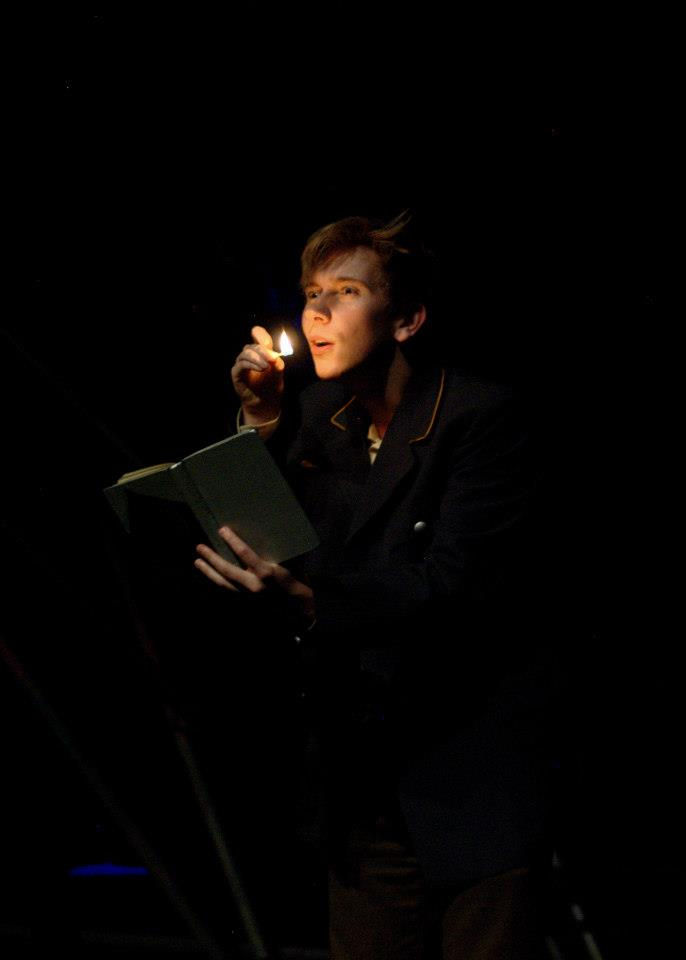

Director's Note:
"How I, then a young girl, came to think of, and to dilate upon, so very hideous an idea?" - Mary Shelley, 1831 Preface, Frankenstein.
When I first read Frankenstein, I had just turned 19. I was a year older than Mary Shelley when she began to write Frankenstein, which is always a sobering thought for a young person wrestling with their own achievements. i was moved, but didn't really know why.
A year later, struggling to make sense of a few changes to my life, I remembered the novel again, It had a different sort of impact. Ideas clicked into place. I understood why Mary had that incredible inspiration she had. The more I read about Mary's life, the more I understood how she could have conceived Frankenstein. It was a story about a powerful, beautiful man rejecting the lifeless flesh he had created. A man whose actions bring untold suffering on the people who love him.
For me, Frankenstein is more, far more than a warning about the limits of science - it is a story about the vulnerable suffering at the hands of the powerful. we all have the potential within us to create or to destroy. It is what we choose to do with that power that matters. It's time to confront the Creature.
Cast and Crew:
CAST
Victor Frankenstein - Alex Monks
Creature - Josh Finan
Walton - David Jeffrey
Henry Clerval - Doug Dunn
Elizabeth Lavenza - Emily Keston
Caroline Frankenstein - Ellen Jurczak
Alphonse Frankenstein - James Travers
William Frankenstein - Anna Dobrucki
Isolde - Rachel Turner
Jacek - Francis Edouard-Whittaker
Justine - Jenny Pendriss
Jadwinga - Cate Berry
Petra Waldman - Rosa Walling-Wefelmeyer
Harriet Krempe - Becky Danks
Agatha De Lacey - Thalia Caddy
Arthur De Lacey - Ollie Raggett
Felix De Lacey - Matt Woodhead
PRODUCTION TEAM
Director/Writer - Charlie Steele
Assistant Director/Deputy Stage Manager - Nazareth Gale
Producer - Lucy Weston
Stage Manager – Hamish Ellis
CREW
Technical Officer - Robyn Park
Cinematographer - Stu Gresham
Costume Designer - Caitlin Hare
Creature Designer - Jess Waller
Lighting Designer - Chris Irving
Composer -Matthew Malone
Set Designer - Dan Turner
Reviews
As the lights flash and the tension rises, a deformed creature convulses into life. The audience sit spellbound for the duration of Frankenstein, the University of Sheffield Theatre Company’s latest production. Charlie Steele, a young writer and director studying at the university, retells the well-known story of Victor Frankenstein – a scientist who loses himself to the pursuit of eternal life.
Steele’s small cast dominates the intimate space, moving like a well-oiled machine to bring this horrific tale to life. With less than twenty people in the ensemble, not a single actor feels out of place.
The script, albeit weak in places, draws out the emotional depth that sits at the heart of Mary Shelley’s ‘hideous progeny’. It is a gallant effort from Steele and the moments of impassioned honesty are incredibly engaging – especially during the play’s climactic second act. Steele also directed the production: unleashing the emotions of her young cast with notable moments of artistry.
The actors themselves harbour true potential, despite their inexperience and occasional lack of polish. Alex Monks is full of masterful magnetism as the disturbed Victor Frankenstein, whose increasing fragility is beautifully portrayed. It is all the more impressive that Monks is a first year student and SUTCo newcomer.
Suitably doting and charming in equal measure, Doug Dunn plays the faithful Henry Clerval – stealing the audience’s hearts. Emily Keston is equally endearing as Elizabeth Lavenza, with moments of real engagement when she is at her most vulnerable. David Jeffery carries off a sweet, high-spirited portrayal of Robert Walton, whose own complex story parallels Victor’s.
However, it cannot be denied that Josh Finan steals the show as the creepy, Benedict Cumberbatch-inspired creature. Although his physicality emulates Danny Boyle’s National Theatre direction to an almost transparent degree of dedication, his unique approach to the dark humour of the character ensures that his performance feels fresh. Using the creature’s naivety as inspiration for moments of light relief, Finan brings a crucial sense of humanity to the role.
Much of the show’s strength lies in its use of design elements: from startling projections to sharp, modern staging. The potential of the small space is harnessed with the use of intense, evocative snatches of film that help to bring Steele’s adaptation of Mary Shelley’s haunting text to life. Ultimately, despite lacking polish in some areas, SUTCo’s new adaptation sees Frankenstein’s creature claw its way into a twenty-first century context with all the fury of the original creation.
6/10
-Lauren Archer, Forge Arts, 31st January 2013